Systeme.io Pricing: Find the Plan Your Funnel Actually Needs
 OSI Affiliate Reviews DeskEditorial team
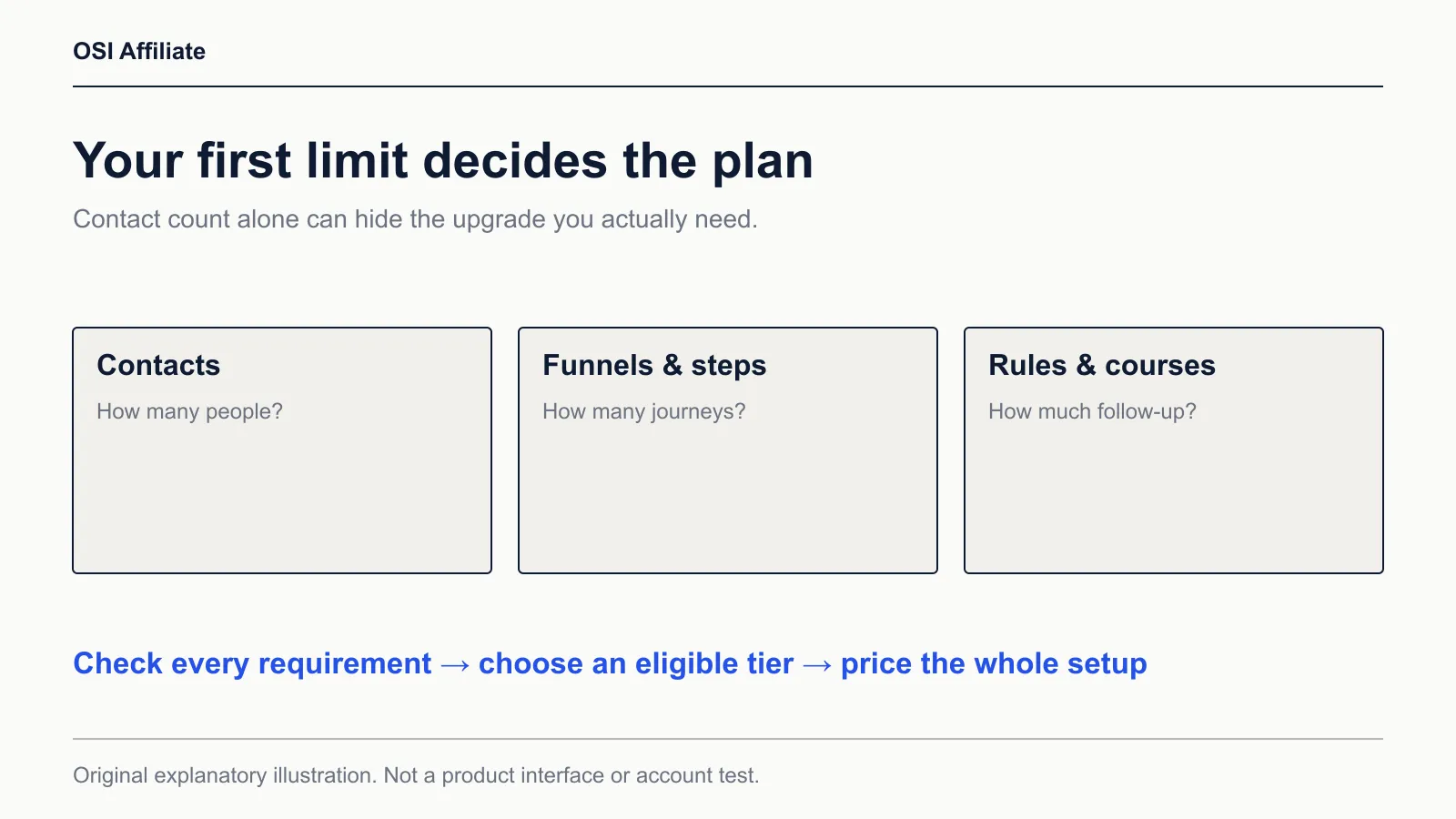
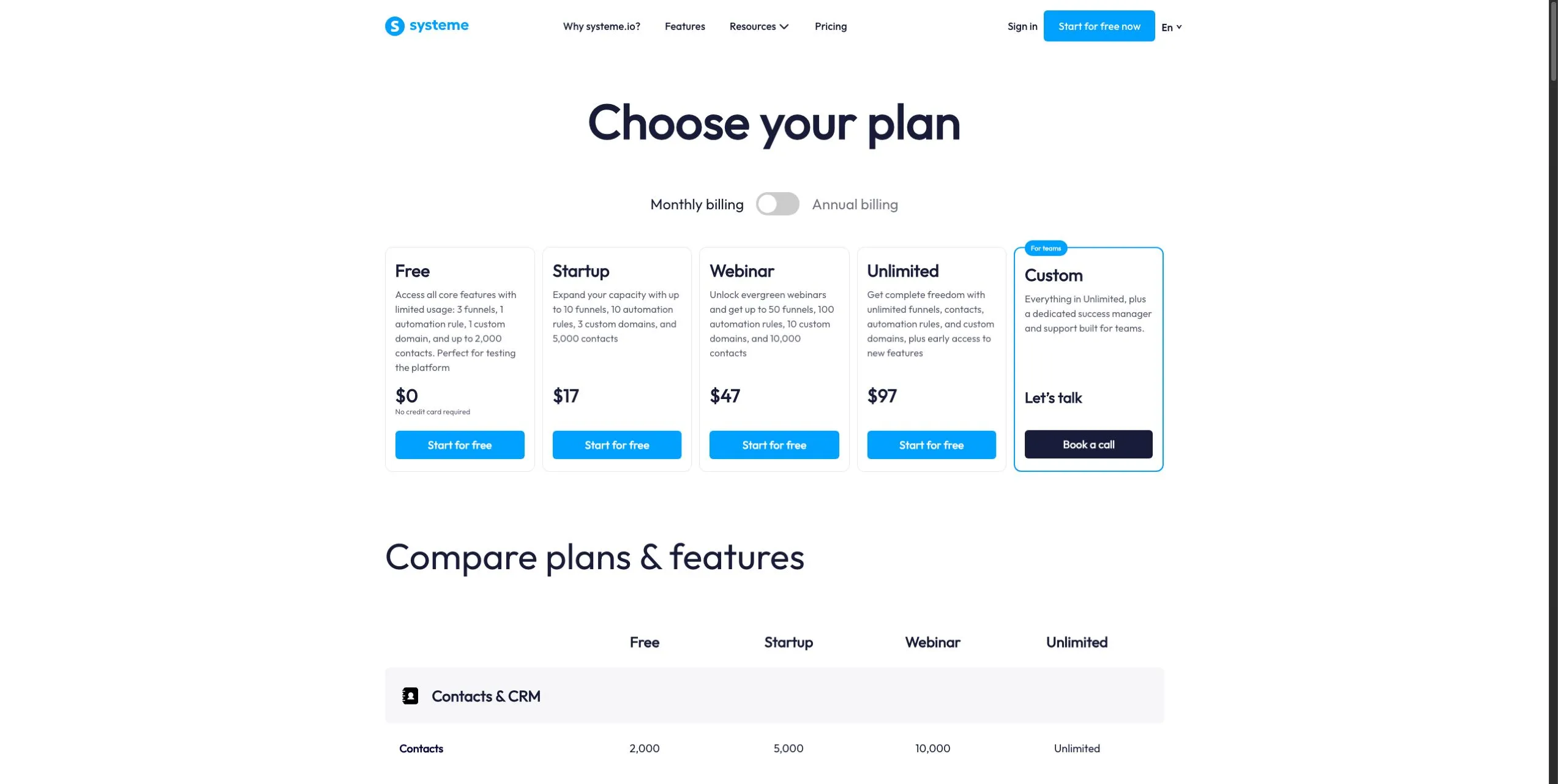
The pricing page is easy to read as a contact chart: 2,000 contacts free, 5,000 at $17 a month, 10,000 at $47, unlimited at $97. If that were the whole story, plan choice would just be list size.
But the limit that bites first can be somewhere else. The free plan includes 2,000 contacts, yes — and only one automation rule, one workflow, one email campaign, and one course. You can hit one of those walls with a few hundred contacts and still need to pay.
The practical starting point: Free if your whole setup fits inside one automation rule, one workflow, three funnels, and one course. Startup at $17 a month if your requirements fit its limits and you need a second rule, workflow, campaign, or course. Webinar at $47 a month matters when you need evergreen webinars — that’s a feature gate, not just a capacity bump — or when you pass 5,000 contacts and stay within its 10,000-contact cap. Unlimited at $97 a month is not a default.
We checked Systeme.io’s pricing page, the rendered plan comparison matrix, and the help center on October 18, 2026. This guide is about the bill and the limits that decide it. For design, workflow quality, and qualitative tradeoffs, read our Systeme.io review separately.
The plans at a glance
Prices are monthly, in US dollars, as shown on the rendered pricing page on October 18, 2026.
| Plan | Monthly | Contacts | Funnels | Funnel steps | Courses | Rules | Workflows | Domains | Evergreen webinars |
|---|---|---|---|---|---|---|---|---|---|
| Free | $0 | 2,000 | 3 | 15 | 1 | 1 | 1 | 1 | 0 |
| Startup | $17 | 5,000 | 10 | 50 | 5 | 10 | 5 | 3 | 0 |
| Webinar | $47 | 10,000 | 50 | 300 | 20 | 100 | 20 | 10 | 10 |
| Unlimited | $97 | Unlimited | Unlimited | Unlimited | Unlimited | Unlimited | Unlimited | Unlimited | Unlimited |
There’s also a For teams tier with custom pricing. Systeme.io doesn’t publish those rates; you book a call.
Every plan includes unlimited email sends, unlimited file storage on webpages, unlimited sub-accounts, 0% Systeme-side transaction fees, and 24/7 email support. But these plans aren’t purely capacity differences. Evergreen webinars appear only from Webinar up, and Unlimited adds early access to new features.
One more boundary on the word “unlimited”: the $97 plan removes caps on the fields above, but at least one other surface — CRM pipelines — still shows a numeric limit of 100 in the rendered matrix. So it’s unlimited on the listed limits, not literally every product surface.
What the free plan actually runs
Free is broad: up to three funnels, email collection, one course, one custom domain, payments, and unlimited email sends, all without a credit card. It’s a lasting plan, not a trial that expires after 14 days.
The configuration counts also constrain Free. You get 1 automation rule, 1 workflow, 1 email campaign, 1 tag, 3 funnels, 15 funnel steps, 1 course, 1 custom domain, and 1 website. There are no evergreen webinars.
A rule pairs a trigger — say, a form submission — with one or more actions, such as tagging a contact and adding them to an email sequence. A workflow is the multi-step version: delays, conditions, branching, and several actions inside one flow. The plan limits the number of rules and workflows.
The classic snag is a lead magnet plus a tripwire offer. Delivering the lead magnet uses your one rule. Tagging buyers so they don’t see the same offer again is another coordination point, and with one tag available, that segmentation runs out quickly. Free works when one simple flow covers the whole job. As soon as you want separate automations, you pay.
There’s also a setup step that surprises people: domain authentication is mandatory before you can send email from a custom domain. Systeme.io’s help article describes adding three CNAME records plus a DMARC record at your domain host, then confirming the sender address. Skip it, and your branded email doesn’t go out.
On students, trust the table, not the footer. The pricing page’s all-plans section says students are unlimited, but the rendered comparison matrix shows the free plan allows 500 students on its one course. We’re using 500, because it’s the more specific figure and there’s no evidence the free plan exempts the student limit.
The limits that force an upgrade
The pricing page’s contact-based selector suggests list size is all that matters. Five small-audience cases show otherwise.
The course creator with 1,400 contacts and three courses. Free holds one course. The remaining contact headroom doesn’t help when course number two doesn’t fit. Startup allows five courses, so three fit there.
The email campaigner with 900 contacts and four campaigns. Free allows one email campaign. Newsletters are unlimited across plans, but distinct campaigns — onboarding, promotion, re-engagement — count separately. Four campaigns require Startup’s ten-campaign allowance.
The automation coach with 600 contacts and four rules. Free allows one rule. Separate rules for form signups, purchase receipts, course access, and a re-engagement branch need Startup’s ten.
The two-brand operator with 700 contacts and two domains. Free allows one custom domain and one website. Running a coaching brand and a course brand as two sites requires Startup’s three domains and five websites.
The evergreen webinar host with 3,000 contacts and two webinars. Evergreen webinars aren’t available on Free or Startup — both show zero. Even though 3,000 contacts fits inside Startup’s 5,000, the feature itself forces Webinar at $47 a month: a $360-a-year increment above Startup under monthly billing, driven by one feature rather than a bigger list.
The shared pattern: Systeme.io’s pricing is often depth-gated, not just contact-gated for small operators. You pay when your automation or funnel structure outgrows a one- or two-flow setup, even while your list stays small.
Your real first-year cost
These are the totals if you pay monthly — the exact annual option needs separate verification, which is why these are calculated from monthly rates rather than quoted contracts.
- Free: $0 in Systeme.io fees. That isn’t $0 total. You still need a domain, and the help center describes connecting a domain registered outside Systeme.io; your registrar sets that price separately. Payment processing also sits outside the platform’s 0% transaction fee. If you take cards through Stripe or PayPal, that processor charges its own transaction fee — get a current quote from your processor account rather than assuming it’s zero.
- Startup: $17 a month, or $204 across 12 monthly payments, before processor and domain costs.
- Webinar: $47 a month, or $564 across 12 monthly payments. That’s $360 a year above Startup, and it buys evergreen webinars plus generous capacity for rules (100 versus 10) and workflows (20 versus 5).
- Unlimited: $97 a month, or $1,164 across 12 monthly payments. That’s $600 a year above Webinar. It removes caps on the fields above, adds early access to new features, and unlocks the monthly-plan free migration.
The critical caveat sits in that “annual” note. The pricing page shows an annual billing option with a “2 months free” banner, but we could not verify an exact annual total, whether the discount repeats at renewal, or what happens to migration eligibility if you later change or cancel. Before prepaying, get the checkout quote and ask those questions directly. Don’t assume the annual fee is twelve monthly payments minus two.
Upgrade, downgrade, and getting out
Upgrading is self-serve: you can upgrade from your account settings at any time.
Downgrading is more involved. The pricing FAQ gives two routes: contact support and convert the remaining paid days into the lower plan, or cancel, wait until the account reverts to Free at the next billing date, then upgrade to the tier you actually want.
Cancelling keeps your paid access until the next billing date, then the account reverts to Free.
What we don’t know from the public pages is what happens to over-limit data at that moment. If you cancel Webinar with 8,000 contacts, does Systeme.io freeze the excess, block new sends, or something else? The pricing FAQ doesn’t say. So before cancelling or downgrading, confirm what you can export and keep your own copies of contacts, course content, funnel copy, and customer records. Don’t assume the platform hands you a clean backup on the way out.
Migration: what you can move in
Systeme.io’s free migration service matters if you’re coming from ClickFunnels, Kajabi, Teachable, Kartra, Podia, Mailchimp, ActiveCampaign, Keap, or WordPress/WooCommerce, among other major platforms.
Eligibility is specific: the Unlimited monthly plan ($97) or any annual plan. That means a Startup annual subscription also qualifies. The team rebuilds sales pages, funnels, email sequences, products, courses, customer records, and affiliate setup in your new account. You provide access — screenshots, export files, or a read-only login — while your old platform stays live. The migration page says not to cancel the old tools until everything is confirmed working.
Timing is scope-dependent and vendor-stated. A simple migration with one funnel and a small list typically takes 2 to 5 business days; larger course and automation migrations can take 1 to 2 weeks. Ask for a written scope and timeline after the team reviews your setup rather than treating the range as a promise.
Plan-fit checker
Use the checker below to find the lowest Systeme.io tier where your actual numbers fit: contacts, funnels, funnel steps, courses, automation rules, workflows, custom domains, students, and evergreen webinars.
Three cautions. First, this is a fit checker, not a platform recommendation — it tells you the cheapest tier that holds your numbers, not whether Systeme.io is the right tool for your business. Second, zero is a valid input; if you have no courses, enter zero. But a real business with all zeroes doesn’t need any platform, and this checker won’t say that, because it only does arithmetic. Third, annual billing isn’t modeled here because we couldn’t verify exact annual totals; results reflect monthly rates.
You can also open the standalone plan-fit checker or download the blank requirements and quote checklist to prepare your numbers offline or hand them to a VA.
Find your documented Systeme.io plan fit
Enter your actual requirements. The first plan that fits every listed limit appears below. A small contact list can still need a paid plan.
Lowest documented capacity fit
Capacity fit is not a purchase recommendation. Check tags, email campaigns, other features, access and actual workflow behavior. “Unlimited” applies to these listed fields, not every product limit.
Monthly USD prices checked 18 October 2026: Free $0, Startup $17, Webinar $47, Unlimited $97. Yearly examples total 12 monthly payments; they are not annual-contract quotes. The advertised annual offer needs a current checkout quote. Domain registration, tax, processor and other-tool costs are separate. Entries stay in your browser.
What to verify in a free pilot
Before you pay for any tier, run these checks inside the free plan:
- Build one real funnel with your actual copy and count the steps. If you need a 16th step, Free’s 15-step cap stops you.
- Map your automations to rules and workflows. Free gives you one workflow.
- Authenticate your domain early. Systeme.io’s domain help article notes records can take up to 24 to 48 hours to fully propagate, and you still have to confirm the sender address.
- Run a test checkout in your processor’s test mode with a test card. Confirm the flow works. Don’t send a live payment.
- Enroll an owned or consented test record in your course to check access and email delivery. Use an address you control rather than someone else’s inbox.
- Write down your upgrade trigger now. “If I pass 2,000 contacts or need a second workflow, I move to Startup.” Decide before the limit hits.
Your plan decision
Choose Free if your numbers fit — up to 2,000 contacts, 3 funnels, 15 steps, 1 course, 1 rule, 1 workflow, 1 email campaign, 500 students, 1 domain, and no evergreen webinars — and you can operate inside those bounds. Don’t pay just because “paid feels safer.”
Choose Startup at $17 a month if you exceed a Free cap and still fit Startup’s limits: more than one rule, workflow, campaign, or course, more than three funnels, over 15 steps, over 2,000 contacts, or more than one domain.
Choose Webinar at $47 a month if your requirements fit its limits and you need evergreen webinars, more than 10 rules, 5 workflows, 10 funnels, 50 steps, 3 domains, or 5,000 contacts. That last one matters twice over: a list of 5,001 contacts can’t fit in Startup even with no webinar plans at all.
Choose Unlimited at $97 a month if you exceed Webinar’s limits, want the free migration without committing to an annual plan. If your whole operation fits in Startup or Webinar, paying for Unlimited only lifts caps you’re not hitting.
Skip Systeme.io if your priority is a full design-led site or content business rather than a funnel-and-offer bundle — our website builder category covers tools built for that job. If you’re switching from an existing email platform, our email platform migration guide walks through what to export and hand over.
Before you pay: run the pilot checks, get a real annual quote if annual billing tempts you, and let the review cover the qualitative side of the decision that numbers alone can’t settle.
Method and evidence limits. OSI Affiliate researched this guide using public primary sources on October 18, 2026: the Systeme.io pricing page and rendered plan matrix, the free migration page, the marketing automation page, the domain connection help article, and the domain authentication help article. We did not create or access a Systeme.io account and did not test the platform hands-on. We did not measure support response times, deliverability, page speed, or usability, and we could not verify exact annual checkout totals — the public annual toggle did not produce a reliable figure, so we treat those numbers as unconfirmed. Prices are US-dollar monthly amounts shown on the public pricing page on the access date; Systeme.io may change them.
Affiliate disclosure. OSI Affiliate may earn a commission when you purchase through links on this page. That does not change our conclusions or the order products appear. We choose what to recommend and what to skip using the same criteria whether or not a vendor pays commission. See our How We Pick page for the full method, About for who we are, and Disclosure for the commercial detail.
Correction path. If a limit has changed since the access date or you spot an error, reach us through the Contact page and we’ll review and correct it.
Last substantive research review: October 18, 2026.

Written by
OSI Affiliate Reviews DeskEditorial team
Business-software reviews, comparisons and buying guides for small teams. We compare vendor documentation and pricing, explain the limits of our evidence, and identify affiliate links. Each guide states whether it includes account testing, public demos or documentation research.